
Abolition, a Portal to a Better World
by aurelius francisco, FLM’s Narrative Organizing Strategist
Many have inquired when we share our practice and belief in abolition at FLM. In the spirit of education, this writing is an explanation of what abolitionists do, believe in, and how abolition shows up in FLM’s work. My intention is not to evangelize, but to state clearly what it means to be an abolitionist organization. Consider this an invitation…
A college student sits in front of a script, preparing to give his first sexual violence prevention training to college freshmen who would prefer to be anywhere but here. But he knows the information on consent and bystander intervention matters. In the victim resource section, the script reads “Optional: Call 911.” He wrestles with whether he will state this optional “resource” for all of half a second. In his home, he saw the police take his sisters’ report. And he saw the abuse keep happening. In his body, large and Black – much too similar to Mike and George and Terence and Freddie and Bennie and… he knew the police were not a source of support for most. But there had to be real help somewhere for people experiencing the life-altering trauma of violence.
A read of Angela Davis’ “Are Prisons Obsolete,” a Mariame Kaba essay, an on-campus lecture from Damien Sojourner, and a couple of podcasts later, he squarely aligned as an abolitionist.
This is my long-story-short journey to carceral abolition. It was swift, aided by being consumed in the learning environment of a college campus and an upbringing that was critical of policing. But this conclusion was not inevitable. Numerous societal levers could have pushed me to advocate for “community policing” or for harsher sentences for people who cause harm. Instead, I’ve settled on the known and unknown that is abolition. The known ancestral traditions of circlekeeping. The knowing that police and prisons have meant far more harm than good in my family and community. All balanced with the unknown of experimenting with new-old ways of responding to harm through transformative justice and community safety, separate from the carceral state.
FLM is an abolitionist organization. This word is new for many, scary for some, and a pipe dream to others. For us, it is a source of grounding. Abolition is a political vision that changes the conditions that have made it possible for prisons to be the response to far too many social problems rooted in poverty. Abolition envisions a world of safety rooted in interconnected community assets. Assets like culturally relevant education, reliable public transportation, beautification, sidewalks, street lights, art, community gardens, and food markets. Neighbors who know each other and care for each other. Properly resourcing these networks in each and every community would alleviate the vast majority of criminalized actions that occur in our neighborhoods, from stealing to drug misuse. Further, if families’ needs were met in this way, intergenerational trauma cycles would cease, leading to healing rather than harm being hereditary.
Abolition is also a practical organizing strategy. That means as abolitionists, we are not only working from a futuristic place but one fully aware of our current realities. Instead of falling into the trap of reformist reforms like more training for cops, we focus on abolitionist reforms like getting cops out of schools so that students can learn free from the threat of surveillance and violence1.
Abolition is not a pipe dream. It is a sober analytical tool that understands the roots of policing and prisons. We do not kid ourselves into believing that the police are here to protect us. Slave patrols did not protect us in 1826, and the police do not protect us in 2026. The police are here to maintain order, a hierarchical order of white supremacist patriarchy. Look at any protest where property is defended, and human lives are treated like carcasses. FLM comes to abolition through study and struggle–the practice of engaging with scholarship and practicing abolition. Abolition is SAFE Commune, a transformative justice network building a durable survivor-centered process to end harm and violence in our community without cops or cages. Abolition is We, the Eastside Community Walks, knocking doors to build relationships with our neighbors across northeast Oklahoma City, because one of the biggest social determinants of health is community–so we are building it. Abolition shows up in the People’s Budget Coalition with Home Base, where we advocate for funding people-focused services and resources like parks and recreation, violence prevention, and public transportation. These projects all produce community safety–and are rooted in abolitionist principles.
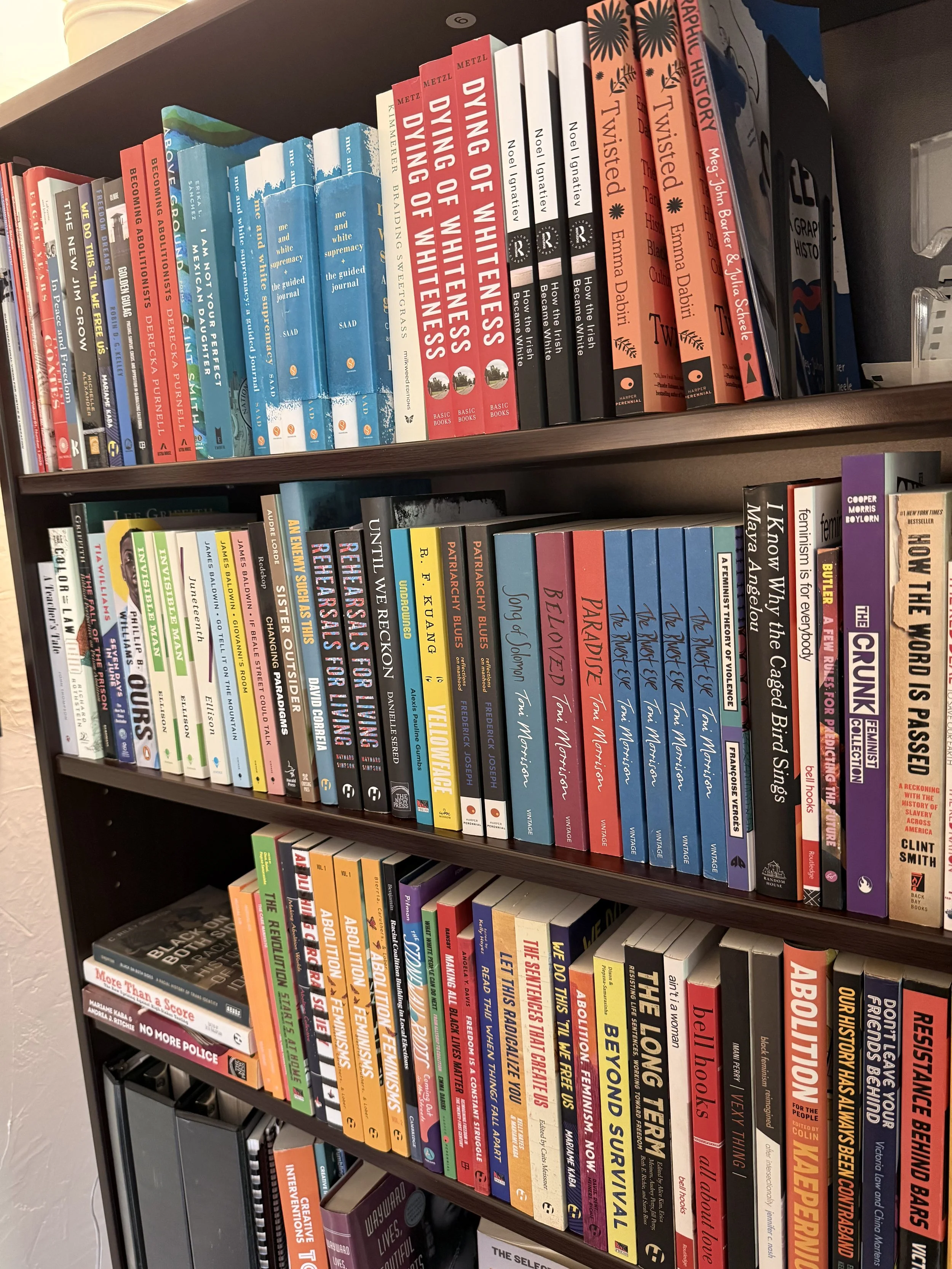
The study of abolition is crucial – by fine-tuning our analysis and perpetually learning more about movements that have been around for generations, we increase our intellectual capacity and implement our learnings into our work. From 2020’s Study and Struggle to our Abolitionist Study Group with Tulsa Intersectional Care Network in 2023, to Home Base’s reading group in 2025 – we engage with research that deepens our knowledge of the possibilities of liberation.
As an abolitionist organization, we work with people who are not abolitionists every single day. We are in coalition with people across the status quo-reformist-abolitionist spectrum. This piece is to clearly state our principles, not to convince anyone else. Though we welcome the opportunity to share our perspective and leave the door open for partners and community members to be radicalized, we have landed on abolition because it is righteous and just, not to virtue signal or condescend to anyone. In my experience, most people’s hesitation toward abolition is rooted in a few things: fear of the unknown, ignorance, and a culture of punishment and revenge.
When I say “abolition is a political vision and practical organizing strategy working to end reliance on prisons, policing, and other forms of carcerality, and build communities of safety.”
A common retort is: “So if prisons are gone, what do you do with the bad guys?”
The premise of this question is connected to years of carceral stories that have told you to fear your neighbor. To look suspiciously at the homeless man walking down the street. The question also implies that everyone in prison is a bad person. As someone who’s visited prisons across Oklahoma and spent hours with incarcerated people, I can assure you that is not the case. There are people in prison who made terrible mistakes and are great human beings. I choose to see their humanity because the human condition is complex. Those same people who made that mistake have been in prison for 40 years. Our system locks people up and throws away the key. This is not rehabilitation or correction; this is punishment. Our parole system is so deeply corrupt that many people spend their whole sentence, even if they’ve been a model citizen and received every certificate and taken every class in prison.
The better question is, how do we reckon with violence?
This question isn’t rooted in racialized fear, but is an honest inquiry about an unfortunate reality in our world today. Violence happens. People commit acts of violence against other people in their homes, at schools, and in neighborhoods. The understanding of what we do about this reality is where the work of abolitionists flourishes. We don’t rely on the ineffective, racist, and expensive response of incarceration, because incarceration is a form of violence. There’s a great scene by one of my favorite actors ever, Viola Davis, (in a show that is far from nonviolent), but it is useful to take a glimpse into the routine psychological violence of solitary confinement. She takes the jurors into just a single minute of being trapped in a cage. She asks them what being stuck in there would do to their mental health. Tough-on-crime pundits would say this is deserved because they are criminals. We say this is inhumane, and no person should be subject to the prison’s torture. Deeper than this ethical question of inhumane violence in the prison system is the cycle of violence. At some point in this cycle must come an intervention. If this intervention is prison, a deeply violent place focused on punishment and not rehabilitation, then violence only continues. It may stop momentarily in a particular instance, but 90% of people in prison will get out. And what the prison offers is not focused on changing behaviors.
The abolitionist answer to violence is not a single institution but a mix of community-based responses combined with the long-term work of societal and cultural change. One core ingredient of this mixture is the resources mentioned earlier in this piece. The next ingredient is community-based responses, including Transformative Justice (popularly known as Restorative Justice), Community Violence Intervention, mental health crisis response, and more. You can find additional examples on the One Million Experiments website. Importantly, we have prevention, which is where cultural shifts must happen. “One ounce of prevention is worth a pound of cure,” says Benjamin Franklin in 1736. Violence prevention is about changing paradigms. In the gender-based violence prevention field, we hone in on creating cultures of consent and healthy relationships, teaching people to understand consent in both sexual and nonsexual contexts, and healthy communication and boundary setting in romantic and nonromantic contexts. This education is about building the psychological foundation to avoid the violence of intimate partner abuse or sexual assault from happening. This work is done on college campuses, in select communities by nonprofit organizations, and in some places, supported by local governments. Imagine if these efforts were standardized in communities everywhere. If it were the norm to understand and talk about consent and healthy boundaries, to talk about and understand our bodies from a young age, to disrupt the stigma surrounding natural occurrences, we all go through. Imagine making it normal for young men to talk about our feelings and communicate our emotions to trusted friends and adults. Imagine ensuring all people have access to recreational activities and community. Imagine all people have access to processing support or counseling when they have experienced trauma. Imagine a nationwide effort to prevent childhood trauma. All of these imaginations are feasible if we simply had the will. And focusing on these preventative measures would necessarily decrease serious violence. As an abolitionist, I want safety for all people, and that value drives my research and organizing efforts.
There is a reality of general ignorance around what abolition is. Collectively, as a society, we are familiar with the police. We know that three-digit number, whether we get in a car wreck or somebody breaks into our home. They provide a semblance of security in our lives. We don’t know a world without police in our lifetimes or that of four generations prior. But what do the police teach us, really? To surveil our neighbors? To have a broad sweeping mistrust of people who look a certain way? To avoid certain parts of town? If the answer to these questions is in the affirmative, then that isn’t a community, but a divided nation. A part of this knowing is also what scholars refer to as the “pedagogy of policing”2. The police have taught my people that we are less than. To always assume that we are in the wrong. That any sudden movement could mean the end of our lives. None of this instruction provided by the police is about safety. It is about social control–keeping racialized and poor people in a place of subservience. This is not what a system of safety should produce.
Abolition is an invitation to a better world. One with systems not rooted in punishment. One without racial capitalism. One full of community safety, accountability, hope, solidarity, and mutual reciprocity. In sum, a labor of love.
1 https://criticalresistance.org/resources/reformist-reforms-vs-abolitionist-steps-in-policing/
2 Miller, Reuben & Miller, Janice & Zeleskov Djoric, Jelena & Patton, Desmond. (2015). Baldwin's Mill: Race, Punishment, and the Pedagogy of Repression, 1965–2015. Humanity & society. 39. 456-475. 10.1177/0160597615609188.lives
